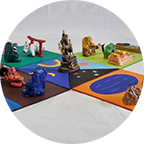
Bhagavad Gita, Chapter 1: The Yoga of Arjuna's Despair
Bhagavad Gita. Translation from Sanskrit, Commentary, and Illustrations: Smadar Pyatsky with Vladimir Pyastky. Translation to English from Russian: Hanan Pyatsky.
Preface
Bhagavad Gita was first introduced to me in 2008, during the military
operation called "Cast Lead". At that time, I and my older brother
were children. When we heard the sirens alerting us of the rocket
attack, it was the first time we strongly experienced a threat to our
lives.
Our father, Vladimir Pyatsky, used to tell us stories at bedtime. When
the war started, he began reading Bhagavad Gita to us before we went
to sleep. Father explained to us that we have to be brave like Arjuna,
and we have to know that if we overcome our vices, we will not be
scared of death anymore.
During the time I was studying in high school, my father advised me
to return to reading Bhagavad Gita. While examining various
translations of the text, I encountered many difficulties. Then I have
fully realized the simplicity and the comprehensiveness of how our
father retold Bhagavad Gita to us.
I have found that the reason for my father's comprehensive retelling
lies in his deep knowledge and experience in Yoga and meditation
practice, which allowed him to penetrate the deep meaning of
Bhagavad Gita.
A few years later, I started to translate Bhagavad Gita to Russian
directly from Sanskrit, to comment and to illustrate it. My intention
was to make the text's deep meaning more clear to the wider circle of
its readers. In the commentaries to the text, I have wrote down
explanations given by my father, which he based on fragments of
classical texts about Yoga, from the Pali Cannon and descriptions of
the experience of Vaishnavi, Shaivi, Shakti and Buddhist masters.
I wish to express deep gratitude to my father and teacher – Vladimir
Pyatsky, for his constant direction and assistance on each stage of this
work.
I am grateful to my mother, Olga Pyatsky, for the blessing she gave
me for doing this work, and for her edits of the text.
I want to thank my brother, Hanan Pyatsky, for the translation of this
text to English, for photography of the sculptures, the paintings, and
for designing this PDF ebook.
I want to thank Dorey Glenn for his grammatical editing of the
English translation.
Smadar Pyatsky
Yavne, Israel
2019
Chapter 1: The Yoga of Arjuna's Despair
1.1 Dhritarashtra said:
“On the field of Kuru, the field of justice, my sons and the
sons of Pandu gathered, ready to fight. What is happening
between them, Sanjaya?”
The name Dhritarashtra means "Ruler of a Powerful
Kingdom".
Pandu – Dhritarashtra's brother, whose name means "White".
Sanjaya – Dhritarashra's advisor, whose name means
"Victorious".
Dhritarashtra is a king who was born blind, and whose sons
are enemies with the true heirs of the throne, to whom they
refuse to return the kingdom, and thus, are preparing for
battle on the field of Kuru.
Bhagavad Gita is a part of the Mahabharata epic, which
describes the history of the clan of Kuru. Dhritarshtra and his
hundred sons bearing the name Kauravas, according the law,
were obligated to pass over reign of the kingdom to the
Pandavas, who were Dhritarashtra's nephews. However, with
cunning and through manipulation, the Kauravas kept
postponing the transfer of authority. When it became
impossible to postpone any longer, they openly declared
themselves kings, and called the Pandavas to battle. Having
the power in their hands, the Kauravas stopped following the
ancestral laws that were designed to support the wellbeing and
peace of the people. They behaved like cruel tyrants and
destroyers.
The field of Kuru literally means field of action. Kauravas –
"Belonging to Action", that is, engaged in it. Pandavas –
descendants of Pandu. Pandu – literally, "White", implies that
the Pandavas belong to pure mind.
According to legend, Dhritarashtra's father was a great sage
Yogin by the name Vyasa. Vyasa – was one of the greatest
teachers (Rishi), whose lifespan is thought to equal a whole
cosmic era, and to last until the end of the human race on
Earth. When Vyasa appeared in his wrathful form in front of
Dhritarashtra's mother, she shut her eyes in fear. This is why
Dhritarashtra was born blind.
The blindness of Dhritarashtra symbolizes his inability to see
the truth and to teach it his descendants. He embodies an
ignorant mind that gives rise to the myriad vices
(Dhritarashtra has one hundred sons and one daughter). By
clutching onto authority, ignorance is trying to defend itself
against impermanence of existence.
It is said that the entire Mahabharata was told by Vyasa
himself. He also blessed Sanjaya, the advisor of Dhritarashtra,
with clairvoyance in order to cure his son from blindness of
ignorance. The gift of clairvoyance allows Sanjaya to stay in
the palace, but to see and tell the blind king about everything
that is happening on the battlefield.
Dhritarashtra turns to his advisor Sanjaya in order to see the
upcoming battle. The blind king calls the battlefield of Kuru a
"field of justice", a fact which underlines his fear and weakness
in front of the upcoming events. He counts on the possibility
that Sanjaya's magical sight will bring him comfort, and that it
will overcome the realization of the fact that Dhritarashtra's
sons are lawbreakers. However, Sanjaya doesn't tell
Dhristarahtra the desired words of comfort, but things that
solely accord with the truth.
Dhritarashtra – is ignorance. The powerful kingdom –
signifies a heart in which ignorance dwells. Sanjaya – is
enlightened speech. This is why Dhritarashtra is blind, and
Sanjaya possesses the quality of clairvoyance. Bhagavad Gita is
being told to Dhritarashtra by Sanjaya, and thus, symbolizes
the transmission of wisdom to the heart by the means of pure
speech.
1.2 Sanjaya said:
“The king Duryodhana, seeing the army of Pandavas that
prepeared for fight, approached his teacher Drona, and
speaks to him:
Duryodhana – "one who is hard to overcome", the elderly son
of Dhritarashtra, and he is the leader of the other sons. His
name also conveys another meaning: "Attached to Possession
of Wealth" (Durya – abode, Dhana – wealth). The meaning
behind Duryodhana's name is that greed is a vice that is hard
to defeat. Thus, it can be seen that the blindness of egoism
gives rise to greed in the first place, which in turn, leads to a
myriad of bad consequences.
Drona, to whom Duryodhana insinuatingly speaks, taught the
art of war to both Kauravas and the Pandavas. According to
the story, he was born when one ascetic (Rishi) uncontrollably
discharged semen because of strong passion towards a divine
lady (Apsara), and saved the fluid in a container made from a
grass called Drona. Later, Drona himself was born from it.
Drona participates in war on the side of the Kauravas. Lust
comes along with desire of wealth and is embodied by the
Kauravas. Virtue is imbodied by the Pandavas. The other
meaning of the name Drona is "crow" or "scorpion", and that
symbolizes his skill in the art of war.
1.3 “Teacher, watch the powerful army of Pandavas, led by
your talented student, Dhrishtadyumna.
In Duryodhana's words to Drona, his teacher, an accusation
for teaching the Pandavas is contained. He mentions
Dhrishtadyumna in order to irritate Drona's pride.
Duryodhana's accusation shows that he cannot contain his illwill
even in a conversation with his teacher and ally, because
he is afraid that Drona will not be fierce enough in the battle
against the Pandavas.
The army of Pandavas is being led by Drupada's son –
Dhrishtadyumna. One of the meanings of the name
Dhrishtadyumna is Gain of Wealth and Fame. According to
the story, Dhrishtadyumna's destiny was to kill Drona. Despite
that knowledge, Drona taught Dhristadyumna the art of war.
Their bond emphasizes that fame and wealth are devastating
for those who desire them.
In Shlokas (verses) 1.4-1.18 the names of warriors from both
armies are listed. In Bhagavad Gita, these characters represent
allegorically different qualities of mind, and the majority of
them are not further mentioned in any of the following
chapters. In order to preserve comprehensive text, we
generally translate the names literally, and interpret them
according to the history of those characters described in
earlier parts of Mahabharata.
We mention the original names of these characters in our
commentaries. In the shlokas themselves, we preserve the
original (Sanskrit) names of the main heroes only.
1.4 Here, in this war, remarkable warriors that aspire to
greatness participate, such as Bhima and Arjuna, Spirit of
Battle, Greatness, The Mighty Chariot Driver, and Pillar of
The Universe;
Bhima – Fearful, is a Pandava whose incredible power scared
his enemies.
Arjuna – Bhima's brother, whose name literally means
"White", "Pure".
Spirit of Battle – Yuyudhana.
Greatness – Virata.
Pillar of the Universe – Drupada. He is the support and central
pivot-point around which the wheel of the universe spins, and
he is called The Mighty Chariot Driver. Gods and sages who
reached divine realms are called Mighty Chariot Drivers. The
disks of the sun and the moon are compared to the wheels of
the chariot, and The Pillar of Universe is the pivot connecting
the disks of the sun and the moon.
1.5 Above them is a banner of victory, with them are
Intelligence, The Courageous King of Sun and the spirits of
family who bless and unite people;
Banner of victory, one of the eight signs of enlightenment –
Dhrishtaketu.
Intelligence – Chekitana.
God of the Sun – King Kashi.
Spirits of the family, who bless and unite people – Purujit,
Kunti-Bhoja and Shaibya.
Purujit – "Multiple Winner". Kunti-Bhoja – stepfather who
took care of Kunti, the mother of Pandavas. Shaibya –
belonging to the clan of Shibi. Since there is no clear
information on this clan, it can be assumed that it is mythical.
Together, they transmit the spirit of blessing to those who care
about the wellbeing of the family.
1.6 Mettle of Battle and Powerful Vitality, Luck and the
Spirits of Earth – all of them are great chariot drivers.
Mettle of Battle – Yudhamanyu.
Powerful Vitality – Utamoja, a warrior who defeated one of
Duryodhana's Chariot drivers.
Utamoja – "the one whose shine is better than the shine of
gold"; a warrior that beat one of Doryodhana's chariot drivers.
Yudhamanyu and Utamoja were two brothers who protected
the wheel of Arjuna.
Luck – Subhadra.
The Spirits of Earth – the sons of Draupadi. Draupadi –
literally: "flat-footed", that is, she who is completely connected
to the earth. She expresses the power of Earth that accepts and
contains all the creatures after their death. Thus, Draupadi's
sons are the Spirits of Earth.
1. 7 Oh, the best among the twice-born, hear also the names
of our best warriors. I will list the generals of my army:
After accusation, Duryodhana immediately flatters Drona,
calling him the best among the twice-born, using the method
of "stick and carrot". The expression "twice-born" regards
people belonging to high societies: aristocrats – Kshatries, and
religious officials – Brahmins. "twice-born" means that a
person was born both on earth and in heaven.
1.8 Honorable yourself, ancient Fear of Death, Light-
Mindedness, Triumphant Sympathy, Horse Power, Stupidity
and Euphoria.
After Drona, Duryodhana first names the elder of the Kuru
clan, the ancient fear of death – Bhishma. The meanings of the
name Bhishma are Dreadful and Death. Simultaneously with
birth, death appears and thus, with the appearance of the clan,
Bhishma also appears, and becomes the elder of it.
Next mentioned is Light-Mindedness – Karna, whose name
literally means "Eared". He was born because his mother
carelessly chanted a mantra to summon The God of Sun, and
then was bound to conceive a child from him.
Triumphant Sympathy – Kripa. He was born because his
father had left his resolute state of mind (ascetic practice)
when he saw a divine lady (Apsara). He is called triumphant
because sympathy binds the hearts of creatures.
Horse Power – Ashvatthama. This name implies unrestrained
recklessness.
Stupidity – Vikarna, one of Duryodhana's brothers whose
name means Earless, that is, one who lacks understanding –
stupid.
Euphoria – Somadatta, "Given by Soma". Soma is the name of
either a drink that gives immortality to the gods, or an
intoxicating drink that was being prepared in the ancient
times.
1.9 As well as many other warriors that are ready to give their
lives for me. All of them are experts in the art of war, and
they efficiently manipulate many different weapons.
For pleasant experiences, blinded by greed, creatures are ready
to risk their lives because, from their perspective, a life without
pleasures seems meaningless. A mind controlled by greed
becomes incredibly creative in its ways of achieving objectives,
but it only gets further from contentment.
1.10 Our army is being controlled by a boundless fear of
death, while their army is being led by reduction of fear.
Fear of death, represented by Bhishma, makes one's mind
wander infinitely. Reduction of fear is represented by Bhima
because a mind that tends to virtue is able to restrain itself.
1.11 Our army will be led by Fear of Death – the elder of
Kuru. Let him be protected in every place on the battlefield!”
Bhishma is the elder of the Kuru clan to which both the
Kauravas and Pandvas belong. The warriors of Duryodhana
desire power, are attached to existence and fear death the most
of all. This is why Duryodhana controls his army by the power
of fear of death – the general Bhishma. Duryodhana orders to
protect Bhishma in every place of the battlefield, because
wisdom and virtue in the character of the Pandavas are able to
overcome the fear of death.
1.12 And then, the mighty elder of Kuru, Fear of Death that
appeared simultaneously with birth, blew the horn with
delight, producing a powerful sound resembling that of a lion
roar.
1.13 Then, sounds of horns and drums have risen, causing
horrible noise.
1.14 And then, sitting in a majestic chariot with white horses
harnessed to it, Charmer of Senses Krishna and Pandava
Arjuna blew their divine horns.
King Krishna was known as a perfected sage and Yogin, who
reached a liberated state of mind. The Pandava Arjuna was his
close friend. The name Krishna means Dark-Blue. This color
represents extinction of suffering (the state of Nirvana). The
name Arjuna means White or Pure, and it represents
accumulations of virtue.
During the preparation for battle on the field of Kuru, the
Pandavas and Kauravas sent messengers to the king Krishna,
each of them asking him to take their side in the battle. Since
Krishna was a family relative of both sides, he offered them to
choose one of two options: either to take Krishna's army or to
invite Krishna himself to be a chariot driver. Duryodhana
gladly chose to take the army of Krishna, while the Pandavas
chose Krishna himself.
In this shloka (verse), Krishna is called "Charmer of Senses" –
Madhava, which has a twofold meaning. On the one hand, the
senses of the Kauravas were charmed by the accessory richness
and might of Krishna, and because of that they turn away from
Krishna himself. On the other hand, the senses of the
Pandavas were charmed by Krishna's divine wisdom, and
because of that they chose the option that seems non-practical.
1.15 Master of Senses blew the horn of The Five Types of
Human Birth, The Defeater of Greed blew the Horn Given by
Gods, and Wolf Hunger Whose Deeds are Horrifying blew
the gigantic horn of the Heart.
Krishna blowing the horn receives the name Hrishikesha –
Master of Senses. Arjuna receives the name Dhananjaya –
literally, Defeater of Wealth, that is, Defeater of Greed.
Krishna's horn is called Panchajanya, it means The Five Types
of Human birth. Four of them – are births amongst Varnas,
and the fifth – outside of them.
The four Varnas are: Kshatries (warriors), Brahmins (religious
officials), Vayshies (craftsmen and merchants) and Shudras
(hunters and servants). The fifth type of birth – is among the
"untouchable". Among the untouchable were foreign people
and those who live amongst them, and also those who were
illegally born. Neither their life, nor their property were
protected by the law.
Krishna's horn bears this name because a liberated mind has
the same qualities in all creatures, regardless of their
background.
Arjuna's horn is called Devadatta – "Given by the Gods".
Virtue unites people and gods, and it is a recognizable quality
of Arjuna that makes him stand out.
Next, after Krishna and Arjuna, Bhima, horrifying, also given
the name Vrikodara – Wolf Hunger in this shloka, blows his
horn. He blew the gigantic horn Paundra. Paundra – means
related to the kingdom of Pundra that is located between two
great mountains. Pundra also means "white lotus". Two great
mountains – two breasts. The kingdom or the lotus between
them – is the Heart.
How did it happen that Bhima, who represents insatiability
became the general of the Pandavas? Insatiability can be
satisfied only by wisdom and self-restraint. The attempt to
satisfy insatiability by the means of fulfilling ones desires bears
the same result as drinking salty water, which not only does
not reduce the thirst, but also brings on madness. Because of
that, Bhima, well known by his trustworthiness, seeks rescue
from his own terrible qualities in communication with
Krishna.
1.16 Spirit of Resistance in Battle blew the horn of Infinite
Delight, Divine Protectors blew the nice sounding precious
horns. After them, all the warriors from the army of the
Pandavas blew their horns:
Spirit of Resistance in Battle – Yudhishthira, Arjuna's older
brother.
Divine Protectors – the twins Nakula and Sahadeva, brothers
of Arjuna. Nakula literally means "mongoose". Mongooses
protect people's homes from snakes. Sahadeva means
"together with the gods".
1.17 Mighty Archer – King of Sun, Great Chariot Driver Who
delivers to The Gates of Brahma, Spirit of Wellness and
Fame, Grandeur and Unconquerable Truthfulness;
Mighty Archer, King of Sun – king of the city of Kashi
(Varanasi) that is considered a city of gods. King Kashi – one
of the names of the god of the sun.
Great Chariot Driver Who delivers to The Gates of Brahma –
Shikhandi, "A Knot of Hair on the Vertex".
Shikhandi – "thread of hair on the vertex". In Yoga, the vertex
is called the gates of Brahma, and the hair symbolizes the flow
of thoughts. Shikhandi is called The Great Chariot Driver
because a thread of hair on the vertex symbolizes a flow of
thought that leads to the realm of Brahma.
The Spirit of Wellness and Fame – Dhrishtadyumna. His
participation in the battle on the side of the Pandavas
demonstrates that the Pandavas wisely use the mundane
achievements to support virtue, and do not seek them as
opposed to the army of Duryodhana.
Grandeur – Virata.
Unconquerable Truthfulness – Satyaka, another name of
Yuyudhana (Spirit of Battle).
1.18 Pillar of The Universe who is the owner/ruler of earth,
all the Spirits of Earth and Mighty-Handed Luck blew their
horns, one after another.
1.19 And then, this horrific roar, echoing from the sky and
the earth, reached the hearts of Dhritarashtara's sons and
caused them to shiver.
1.20 Seeing Dhritarashtra son's army, settled with weapons
and ready to battle, Arjuna, on whose flag a monkey is
depicted, took his bow and said to Krishna:
The monkey depicted on Arjuna's flag – Hanuman, a loyal
friend of Rama. Rama was a virtuous hero-king who
vanquished the malicious demon (Rakshasa) Ravana.
Hanuman provided invaluable help to Rama.
1.21-1.23 “Master of Senses, set my chariot between the
warring armies, so that I can see those who will fight me in
this war, seeking to please malicious Duryodhana”.
1.24-1.25 When he heard Arjuna's request, Krishna placed
his chariot between the two armies, facing Fear of Death and
Passion with their circle and said: “Son of Pritha, look at the
assembly of Kuru Descendants.”
Pritha – another name of the queen Kunti, Arjuna's mother. It
means a unit of land equal to a palm. Addressing Arjuna as
"son of Pritha", Krishna emphasizes Arjuna's connection with
the earth that should support him during the upcoming test.
1.26-1.27 Then Arjuna saw there grandfathers and fathers,
teacher, brothers, sons, grandsons and friends. He saw
relatives and blood-brothers on both sides of the battle-field.
After seeing that, he spoke, filled with pity:
1.28-1.30 I see my relatives, Krishna. They all came here,
ready to fight. My hands drop, my throat dries, my body is
trembling, and the hair stand on end; my bow is falling out of
my hands, my skin is burning, and I cannot think clearly.
The Kauravas represent vices, and the Pandavas – blessed
qualities. Both are presented as the relatives of Arjuna, because
they are qualities of his own mind.
The outcome of the battle will determine who rules the
behavior of Arjuna – sins or virtue.
1.31 The Long-Haired, I see bad omens. I cannot see what
benefit can bring death of my relatives in this battle!?
Long-Haired – Keshava, one of the names of Krishna. Long
hair symbolizes uninterrupted and stable thought. Arjuna
does not want to destroy his relatives – the Kauravas, the bad
sides of his mind, because he has grown up in their company,
and is used to identifying with them. People habitually regard
the contents of their mind as acceptable. Because of that,
Arjuna perceives all of the qualities of his mind as important
to him, regardless of their content.
Arjuna calls his gut feelings bad omens. He sees a bad omen in
a fight against his relatives (his vices), because he feels that it
might lead to disappearance of his conception of his own "I"
1.32 Krishna, I do not desire neither victory and enjoyments
nor a kingdom. What value is in a kingdom, an enjoyment
and saving life, Protector of Earth?
Protector of Earth or Sheperd of the Cows – Govinda, one of
the names of Krishna. It is common to give such names to
compassionate beings.
1.33 After all, those for whom we strive to attain rulership
over the kingdom, enjoyment and happiness, gathered here
to fight, ready to lose their lives and wealth.
1.34-1.35 Teachers, fathers and sons, grandsons, brothers
and other relatives have gathered here. Defeater of
Enchantment by Pleasurable, although they want to kill me, I
do not want to attack them. I would not want to win in this
battle even for the right to rule the three worlds, not to
mention ruling this land!
Three worlds: heavenly world, ancestral world, earthly world.
The pursuit after ruling these three worlds is rooted in longing
for pleasure, which creates the preconditions for rebirth, and
inevitably to further suffering, depletion and death. Thus,
seeking support from Krishna, Arjuna calls him "Defeater of
Enchantment by Pleasurable" – Madhusudana, and in the
following shlokas "Destructor of Birth" – Janardana.
1.36-1.37 Destructor of Birth, what bliss will we achieve by
killing the sons of Dhritarashtra? We will only stain
ourselves if we kill them, even though they are bandits. We
should not kill our relatives.
Altough Arjuna's words sound reasonable, they actually
demonstrate a willingness to live with one's vices in order to
preserve the wholeness of the conception of the feeling of "I".
He is even ready to not protect his good (Pandavas) in order
to satisfy this wish.
1.38-1.39 Greed veiled their minds, they do not see fault in
warring their relatives and friends. But how can we avoid
such a severe mistake, sensible Destructor of Birth?
1.40 Together with death of the family disappears the ancient
order that unites people. They say: “If there is no order,
disorder establishes”.
By saying "death of the family" Arjuna means the death of
noble warriors – the Kshatries, who ruled the ordinary people.
Kshatries establish a common social order, and see that it is
applied. In absence of a force that is responsible for law
enforcement, crimes ensue, and cruel standards are
established.
Social order symbolizes the habits of Arjuna. Arjuna fears that
absence of these habits will put his mind in chaos. Dwelling in
such misconception, he takes his own inner restlessness as a
reflection of the collapse of the whole world.
1.41 When disorder sets in, Krishna, economy declines, and
women give birth after unfavorable marriage.
Death of men in war causes a situation where there is no one
in the family who can provide livelihood. Because of this
decline in the numbers of men, women have a harder time to
find fine partners, and instead, marry others unwillingly.
During deepening of Arjuna's immersion in his doubts, his
bad feelings take a more pronounced form.
1.42 Family, which was formed by bad marriage is similar to
hell. Falling apart of the family leaves the elderly without
support, and they remain without food, water and
medications.
1.43 Collapse of the ancestry and bad marriage become the
reason for falling of the eternal sacred traditions.
1.44 Destructor of Birth, I have heard that as a result of
falling of traditions, names of people get stained; and they
rebirth in hell and dwell there.
Religious traditions teach that if no purification rituals are
performed for the dead, then their name and memory of them
will be stained, and they will be reborn in hell. However, what
really stains Arjuna – is his vices.
Doubts and bad feelings of Arjuna are caused by attachment to
form and name, to coarse and fine existence. At first, he
speaks out his concern about earthly existence, and afterwards
– about existence after death.
1.45 Alas, we decided to commit a great crime, and are ready
to kill our relatives for the sake of greedy enjoyment from
authority!
1.46 Even if I, unarmed and not resisting, will be killed by the
sons of Dhritarashtra, it will bring me more happiness.
When saying that he prefers being killed by the sons of
Dhritarashtra, Arjuna does not realize that all the disasters
that he described earlier can be brought on by seizure of power
by the Kauravas.
1.47 Sanjaya said: “After saying these words, Arjuna, broken
by sorrow, sank down to the bottom of the chariot in the
middle of the battlefield, throwing aside his weapon”.
In the first chapter of Bhagavad Gita there are presented three
appeals from students to their teacher:
1) Dhritarashtra seeks comfort in Sanjaya's wonderful power
of clairvoyance.
21
2) Duryodhana tries to stir/wake up wrath and desire to battle
in his teacher.
3) Arjuna reveals his despair and confusion to Krishna.
The first two types of appeals are not favorable, and lead to
suffering, but Arjuna's appeal, on the other hand, leads to the
gain of wisdom and to cessation of suffering.
This shloka completes the first chapter of Bhagavad Gita
which is called Yoga of Arjuna's Despair". The term Yoga
acquires a central position in Bhagavad Gita, and means the
way that leads to cessation of suffering.
Why is Arjuna's despair called Yoga? The reason is that after
getting lost, Arjuna asks for Krishna's advice. The fact that he
gets down to the bottom of the chariot, throwing aside the
weapons, symbolizes taking the position of a student near the
feet of his teacher, ready to hear the teaching.
Thus ends the first chapter of Bhagavad Gita
Bibliography
The original text of Bhagavad Gita written in Devanagari script, taken
from the website Gita Supersite
https://www.gitasupersite.iitk.ac.in/
Transliteration of the text, taken from the website Sacred Texts:
The Bhagavad Gita in Sanskrit
http://www.sacred-texts.com/hin/bgs/index.htm
Translations to Russian:
Акад. Б. Л. Смирнов. Бхагавадгита, Литературный прервод, Санкт-
Петербург, «Кристалл», 2000.
Акад. Б. Л. Смирнов. Бхагавадгита, Буквальный перевод, Санкт-
Петербург, «Кристалл», 2000.
Бхагавадгита в традиции и в современной научной критике. Ислл.,
перев., коммент. В. С. Семенцова / М.: «Наука», 1985.
Translations to English by the following translators, taken from Gita
Supersite:
Swami Shivananda, Swami Adidevananda, Purohit Swami, Swami
Gambirananda, Dr. S. Sankaranarayan
Georg Feuerstein with Brenda Feuerstein, The Bhagavad Gita, A New
Translation, Shambala, Boston & London, 2011.
GK Marballi, Journey Through the Bhagavad Gita, Seeker 2011, 2013.
Dictionaries:
Monier-Williams Online Sanskrit-English Dictionary, 2014.
Arthur A. MacDonell, A Sanskrit-English Dictionary, Oxford,
1893.
В. А. Кочергина, Санскрито-Русский Словарь, москва
издательство «Русский язык», 1987.