
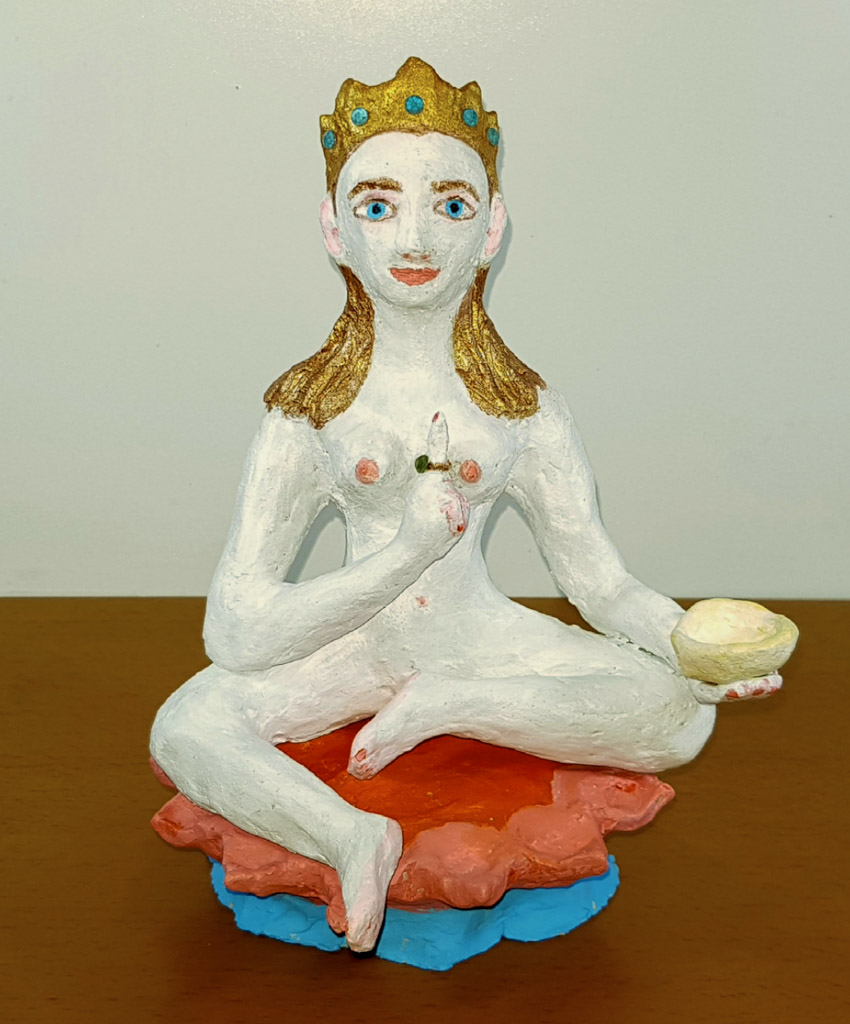
Retelling: Vova Pyatsky and Smadar Pyatsky (based on the translations of the suttas published on Theravada.ru and SuttaCentral.net)
Russian Version: 27. Аганья Сутта (Возникновение мира, полов и каст) | Три Ваджры
Translation to English: Roni Sherman and Marina Sherman
Introduction
Two young brahmins, Bharadvadja and Vasettha, the first conversation with whom Tevijja Sutta (Digha Nikaya 13) is dedicated, after taking Refuge in the Triple Gem, began to live among followers of the Blessed One, renunciates of the world, preparing to be taken into the Sangha. Other brahmins strongly vilified and insulted them, arguing that by becoming hermits, the young men disgrace the highest caste to which they belong by birth. Relatives of Bharadvaja and Vasettha said that brahmins are born from Brahma’s mouth, while wandering hermits — from his feet. Therefore, according to them, by rejecting the highest birth, the young men became trampled and insignificant.
One day, on a summer evening, when, after sitting meditation, the Buddha took a stroll in the shade, the young novices approached Him and bowed, hoping to receive the instructions of the Blessed One. Seeing the confusion of their hearts, the Buddha explained how the world unfolds, men and women appear, and then there is division of society into castes. But above all, the Buddha dismissed the false arguments that the caste of brahmins is nobler than others.
Descent and Dhamma
The wives of brahmins, just as the wives of other people, give birth to children and breastfeed them. Therefore the brahmin’s claim that they come from Brahma’s mouth is false. Disciples of the Arhat however, originating from different clans and castes, whose behaviour, speech and thought are consistent with the Highest Law — Dhamma can call themselves the sons of Truth, born from the mouth of the Arhat, followers of His Dhamma.
The Sakyas, the clan from which the Buddha originated, became, at the time of the described conversation, subjects of king Pasenadi. The Sakyans respectfully rose up with the appearance of Pasendi and bowed to him. King Pasenadi himself however rose up when meeting and bowed to the ascetic Gotama, since he considered His righteousness above his worldly power.
The Buddha also explained that it is not descent, but only sublime behaviour, speech and mind that make a person noble. Since whether he will be reborn after the dissolution of the body in the higher realms or in the realms of suffering depends only on the kamma (karma) created by the person.
The Unfolding of the World
Following the period of the folding of the world, conscious beings abide in light, move in space and are surrounded by radiance. Long time passes, and then, on the surface of the boundless ocean, earth rises. This earth is like ghee and delicious like honey, it is fragrant and arouses the desire to eat it. Beings begin to taste it by taking it on the finger and then they eat until their luminosity disappears. After the concealment of the light of their consciousness, the light of the Sun, Moon and stars becomes visible. The world grows and expands.
The formation of bodies and difference in genders
Then beings who continue to eat the delicious earth form bodies. Some have bodies which are beautiful, while others — not. Then the beautiful beings begin to despise the ugly ones, and the delicious earth disappears, and in its place the ordinary earth appears. Then beings remember with attachment: “Oh, what taste that was!”
On the new earth mushrooms appear, and later — creeping plants and bamboo shoots, which, by taste and smell, are like the disappeared earth. Beings continue to eat those mushrooms and plants, and their bodies become increasingly varied in beauty, become grosser and become tangible. Owing to the development among the beings of greed for food and aversion to ugly beings, the beautiful mushrooms and plants disappear, and beings get used to mourn, having learned loss.
In place of the lost plants reminiscent of the first earth beings eat pure and sparkling rice without husk, growing and ripening in one day. Beings eat this rice and their bodies acquire sexual characteristics. Men and women examine each other, and passion arises in them. Some beings copulate, while other beings express contempt and aversion towards them for what they are doing. They condemn them and fling dirt, ash, and dung at them.
The appearance of castes and laws of society
Then beings, having wished to hide one from another, built shelter and began to stock up rice. They did not only take the food that they needed for a single day, but also stocked up for the next day, week and more than that. From this, the sparkling rice became covered with dust and husk, disappeared in some places and its ripening became long.
Having learned of the lack of food, people began to fence off the areas on which their rice grew, to steal food from each other, and developed cruelty, inventing punishment.
Then people elected the one who is most influential and powerful among them so that he were to punish perpetrators. And from such people arose the caste of rulers, kshatriyas. The Kshatriyas established their law.
Some people thought: “evil has spread among people living together” and secluded themselves in the forest, building huts from foliage, living on alms, meditating and purifying the mind. From them came the caste of brahmins. But those of them who turned out to be incapable of pious life began to live around other people and write holy books, considering themselves to be above others by descent.
Some, leading a family lifestyle, have mastered various trades, and thus arose the caste of vaishyas.
Others began to obtain food by hunting, and thus arose the caste of shudras.
Seeking Higher Law in Hermitage
And one day, one of the kshatriyas, dissatisfied with his own law, left home and became a hermit. And so did one brahmin, and one of the vaishyas and one of the shudras. Thus arose the community of hermits in which neither protection of property nor caste (class) determine the law of life, but the Teaching.
Upon hearing the Buddha’s sermon, Vasettha and Bharadvajja experienced joy and established themselves in their Path.
Conclusion
Vasettha and Bharadvaja, raised among brahmins, thought about the world and the people in it in categories of the tradition preserved in holy scriptures. Therefore the Buddha uses tradition as a basis for explaining the Dhamma. The tradition itself, in the description of the unfolding of the world, contains, in the Buddha’s exposition, a deeper aspect of the practice of mindfulness of the three states of consciousness: from the beginning of the description until when beings begin to eat the earth is a description of the Arupa sphere (deep sleep without dreams, the formless self); from the moment of eating the delicious earth and until the start of the buildings of shelters with stock — is the Rupa sphere (dream with form, the subtle self); from the moment of concealment in shelters (the appearance of physical birth given by parents) and beyond — is Kamaloka (the world of desires, the waking state of consciousness)