
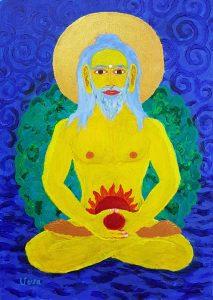
This lecture will be dedicated to the relatives of the Buddha who played major roles in the history of the Dharma. As you may recall, many of the Buddha's family members became part of his Sangha after his sermon in the palace. His father and others remained in the palace and continued to rule the Shakya kingdom and to support the Sangha in its early development. The Sangha was initially very small and included the five ascetics and the Buddha's family members. Later, Shariputra, Maudgalyayana, and another ascetic, Mahakashayapa, who joined the Sangha after them and played a very important role. The Buddha's family members joined the Sangha, the Buddha's aunt, whom he called mother, and his wife, Yashadhara. Yashadhara also renounced worldly life. Although she continued to live in the palace, she became a nun. She wore shabby clothes and ate modest food and avoided participating in the festive events held at the palace.
When the Buddha arrived at the palace six years after his studies, he attained enlightenment and began to give sermons. He thanked his wife for her support, which he had felt during the years he had been on a spiritual quest. He had managed to accumulate knowledge about past lives, and told her that in past lives she had also supported his spiritual path. Therefore, it was not surprising that the Buddha's wife and his aunt, his mother, became the heads of the Sangha of women who had begun to join the Sangha. The Buddha's wife is known to have developed superpowers and supernatural knowledge of the past lives of her disciples.
Another relative who adopted the Buddhist lifestyle was his son, Rahula, who was accepted into the Sangha when he was seven or eight years old. There are two sutras describing how the Buddha instructed his son to the monastic life.
In the first sutra, when Rahula was still a young boy, the Buddha explained to him that in order to have a complete and good life, he must refrain from lying and speak the truth. He showed him a broken pot and asked his son if the broken pot could hold water. Rahula answered in the negative. The Buddha explained to him that this is how the mind of a person who lies is, that it cannot hold the truth or the power of the mind. The mind of a person who lies is like a broken pot. The lie breaks the pot of the mind. He also explained to his son that right words, true words, are the basis of a person's spiritual power. These explanations are extremely important because they explain where the source of weakness is, and where the source of strength is, which are most fundamental to the internal discipline of spiritual study.
This idea also appears in the Sutra of the Sermon on the Mount, where the Buddha speaks about right speech, and also in the proverb: "Life and death are in the hands of the tongue."
In the Buddha's second conversation with Rahula, several years after he joined the Sangha, when the Buddha went to collect alms, Rahula said to himself that his father was so well-known and famous and impressed people, and he would like to be like his father. The Buddha, hearing his son's thoughts, explained to him that attachment to the body, attachment to name and form only leads to disappointment and does not lead to happiness. What leads to happiness is the pure mind. He instructed Rahula to see that his body is unreal and is made up of a collection of energy, the energy of earth, the energy of water, the energy of fire, and the energy of wind. Beyond that, he will find nothing else in the body. All the hard things in the body are the energy of earth, all the things that flow in the body are the energy of water, all the things that create heat are the energy of fire. Everything that is airy in the body and that breathes and is light is the energy of wind. When all these elements are united, the body is alive, but when the body dies, they disperse in space. It should not depend on these factors, but only on the pure mind, which recognizes their existence and its freedom from their existence.
It is also said that Shariputra, who saw Rahula meditating under the tree, suggested that he calm his breathing so that his mind would become clear, not knowing that the Buddha had already given Rahula instructions on how to meditate. The Buddha suggested that Rahula implement Shariputra's instructions. These descriptions demonstrate how human and simple life was in the Sangha, how simple and human the process of spiritual ascent to unattainable peaks was. The connection between heavenly wisdom and human simplicity is extremely important in Buddhist dharma.
Rahula is known for his achievements in giving sermons to the worlds of gods, especially to the Pure Lands. When depicted, he is usually depicted as an old man and is referred to as the teacher of gods. Rahula was highly educated and skilled in preaching to celestial powers like Maudgalyayana.
Three brothers-in-law of the Buddha joined the Sangha. These are: Anurudha, Devadatta and Ananda. Because of Ananda's significant influence on the Buddhist Dharma, a separate lecture will be devoted to him. The three brothers-in-law joined the Buddha's Sangha together.
Anurodha was very devoted to the Buddha and quickly developed supernatural powers. Like Maudgalyayana, he saw the heavenly worlds with the eye of wisdom and used to converse with gods and receive teachings from them.
There is not much information about the life of Anurodha. It is known that he lived a quiet life with his disciples. He taught his disciples to meditate in silence. Even when they had to perform a common task, if words were not needed, they performed the task in silence. They used the power of speech to discuss the Dharma. They used to memorize the teachings of the Buddha and then continue to meditate in silence. Anurodha was known to have special yogic power. He reached such a level of samadhi that he did not need sleep at all. For almost twenty-five years, he did not sleep at all. He remained in meditation, and when everyone went to sleep, he continued to remain in meditation without interruption. Usually only a few yogis enjoyed this ability. It is not necessary, but it showed how great his power of concentration was. When he grew old, on the advice of the Buddha, he allowed himself to sleep.
Wherever Anuradha is mentioned, his modesty and the love of his disciples can be seen as brotherly love. It is said that there was such a strong love between the Buddha and his disciples that their gazes merged as milk and water merge. This atmosphere of goodwill, compassion and brotherhood accompanied Anuradha. He lived for many years and became one of the beloved people in the Sangha, because of his peace and the brotherhood that existed between him and his fellow Sangha members. Devadatta, the Buddha's other brother-in-law, was famous and well-known. He developed supernatural powers relatively quickly. He was strong, full of energy, and his faith was strong. But when he reached certain achievements, he said that he was equal to the Buddha and his status was even higher than that of the Buddha. He believed that changes should be made in the Sangha and that he was the one who could make them better than the Buddha. His lack of modesty imprisoned him in his ego. He saw things in a distorted way. The Buddha told him that his attainment was not complete, that his wisdom was not yet complete. In the Heartwood Sutra, the Buddha addressed Devadatta. He said that when people reach certain spiritual attainments, they become frivolous and decline. He warned other disciples, and the figure behind this warning was Devadatta.
Devadatta actually instigated a rebellion, convincing new monks who had joined the Sangha that he was a better teacher than the Buddha. He caused these monks to abandon the Buddha's Sangha and formed a separate Sangha with Devadatta. He made changes to his Sangha, such as requiring his disciples to be vegetarians. The Buddha, on the other hand, advised his disciples to eat what was given to them by the people who donated food, including meat. Devadatta, on the other hand, believed that his disciples would be purer than the Buddha's disciples if they ate only clean food. He suggested that they develop the purity of their minds and bodies through vegetarianism. Devadatta also began to demand from his disciples behaviors that were characteristic of various sects. At the same time, he was unable to train his disciples and give them a solid foundation, since his knowledge was not as great and deep as the Buddha's. He taught them a few techniques that he knew and spoke of himself as if he had all the superpowers. When he went to bed, he did not say he was going to sleep, but that he was going to meditate. His disciples therefore believed that, like Anuruddha, he did not sleep at all. On one occasion, his disciples discovered him sleeping and even snoring. They abandoned Devadatta, who continued to fight the Buddha by various means. One sutra tells us that once, when the Buddha was passing through the mountains, Devadatta threw stones at the Buddha, causing him to be hurt. It is not known whether this is historically accurate, and it is possible that this sutra contains a metaphorical description of the damage Devadatta caused to the Buddha's Sangha by splitting it. Some sutras tell us that Devadatta later repented and returned to the Sangha.
It is important to see the difference between the humble and enlightened Anuroddha and the arrogant, hateful and jealous Devadatta, who claimed to be enlightened in order to gain fame. We see the different choices made by the Buddha’s two brothers-in-law, each making a choice according to his own inclinations. We can learn from this [that] what can bring us success is when we want to learn the Dharma and give it to others. We understand that the way is not to charm people and appear brilliant, as Devadatta tried to do and failed. The right way is to develop deep knowledge, deep wisdom and infinite compassion, as Anuroddha did.