
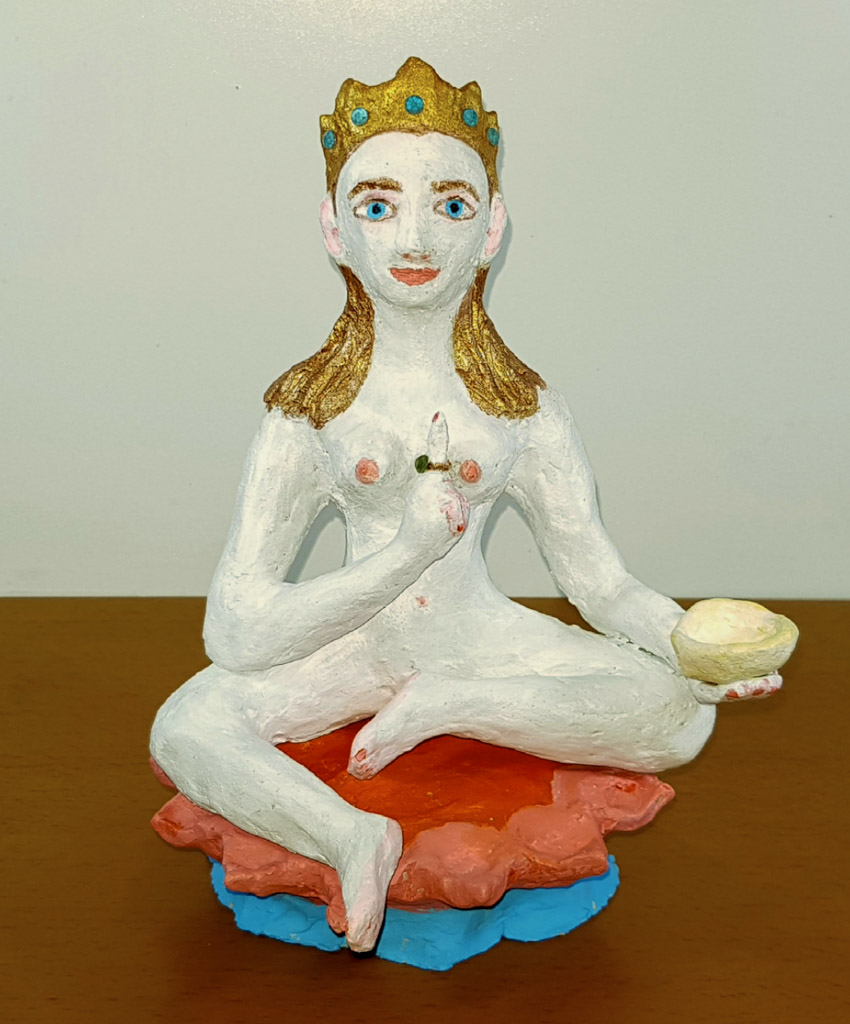
Retelling: Vova Pyatsky and Smadar Pyatsky (based on the translations of the suttas published on Theravada.ru and SuttaCentral.net)
Russian Version: 26. Чаккавати Cутта | Три Ваджры
Translation to English: Roni Sherman and Marina Sherman
Introduction
Chakkavati sihanada sutta — “The sutta of the Buddha’s Lion’s Roar on the Turning of the Wheel of Dhamma”. The Buddha tells his disciples how morality, symbolized by the treasure of the Wheel of Dhamma, comes to flourish, then experiences decline and is reborn again. The wheel was a symbol of power in the kshatriya caste, whose chief military force was war chariots. The Buddha, brought up as a kshatriya, repeatedly turned to this symbol in his sermons, putting into it the higher meaning of the Law of Virtue.
The instructions of the Buddha contain a prophecy of the appearance of the next Buddha — Maitreya, in the age of the revival of Dhamma.
The Golden Age of Dhamma
During the golden age of the morality of the rulers of the earth, the Buddha told, people lived to eighty-thousand years. Governance of the state was based on the rules of preserving the lives of beings, non-possession, restraint of passion, truthfulness, and refrain from intoxication. Thanks to this, the Wheel of Dhamma freely rolled in all directions, and different kings, who had previously been rivals, turned into allies who affirmed the good Dhamma.
When the Wheel of Dhamma, having wobbled, showed the king-sovereign of the world that his life span was coming to an end, he passed the throne to his successor, shaved his head and went into seclusion. The successor followed the same statute of preserving virtue as his ancestor's, maintaining the prosperity of Earth.
The Decline of Dhamma
There comes a time when successors cease to follow the statutes of virtue and the first vice which possesses them first and then the common people — is greed. The king ceases to help the poor with property, and theft appears. Following theft, cruel punishments for thieves appear. People, seeing the cruelty of the authorities, develop cruelty in themselves as well: armed, they steal and kill. People, overwhelmed with greed and cruelty, shorten their lifespan, and in their minds, the difference between beauty and ugliness increases. Desiring to possess the beautiful bodies of other people, people become lascivious and weak, and their lifespan becomes shorter and shorter.
Then lying, denunciation, disrespect for elders and the wise, rudeness, chatter, slander, false teachings spread, which continue to increase passion, hostility and greed.
One day, — the Buddha prophesied, people’s lifespan will reach ten years, and girls at five will already be given in marriage. People will hate each other so much that they will seek to exterminate each other, shouting: “That is not a man! That is a beast!”
And during this epoch, only some people will escape obsession by hiding from the maddened world.
The Revival of Dhamma
Once the time of madness devastates the world, some people who had survived it will leave their seclusion and rejoice to meet each other, embrace each other. And, reflecting, they will understand that because of the development of bad qualities of the mind, the world has become devastated.
These people will begin to watch their speech and thoughts, their actions, not doing evil, wishing good. And, purifying the mind, they will begin to live longer and longer, until their life starts to again reach eighty thousands years, and righteousness will again be established in all of earth.
The Prophecy of the Appearance of Buddha Maitreya
In the age of the revival of Dhamma, a great Arhat will appear, a holy sage, teacher of gods and humans, Maitreya (the real pronunciation — is Metteyya, which comes from the word metta, friendliness). This sage will, on his own experience, attain and explain the truth about all the worlds, their inhabitants and dhammas, as does the Buddha himself. Maitreya will lead a Sangha ten times greater than the Sangha of the Buddha.
Buddha's instructions to the monks
At the beginning and at the end of his story, the Buddha instructs his disciples: be your own Refuge, be your own beacons, taking Refuge in the Dhamma, following the beacon of Dhamma; look after yourselves vigilantly, leaving behind greed, despondency and hostility; abide in mindfulness of the Dhamma without leaving it.
The Buddha explains that a disciple’s longevity depends on the development of four supernatural powers: willpower (chanda); power of self-restraint, discipline (vinaya); the power of the mind (chitta); the power of direct comprehension (vimamsa, experiential comprehension, investigation). Having mastered these powers, the disciple can exist in one form for a kalpa.
The beauty of a disciple consists in high morality, restrained behaviour, careful attention towards his own smallest transgressions.
The bliss of a disciple (sukkha) consists in the attainment of the four manifestations of the radiance of the mind (the four jhanas)
The wealth of a disciple — are the brahmaviharas: friendliness, compassion, joy from communication with virtuous friends and contentment.
A disciple’s power — is in the cessation of craving for the world, and although there is not a more formidable force than the force of Mara (the sense of “I”), Mara also obeys the highest virtue.
Conclusion
As in Mahapadana Sutta, Digha Nikaya 14, life — is one or another world. The subtler the world, the higher is morality in it, the calmer it is, and the longer the duration of existence in it. Correspondingly, the ability of the disciple who has mastered the superpowers to exist for an entire kalpa — means the ability of the disciple to completely exhaust all the vicious qualities of the mind, to attain a state beyond which there is nothing else.
The prophecy of the coming of Buddha Maitreya — is not only confirmation of the ability of the Dhamma to revive in the earthly world, but also a prediction of the Awakening of disciples. Every single one of the disciples — is a world in which a gradual revival of the Teaching takes place until the attainment of Arhatship when the heart of the disciple manifests itself as the Buddha of friendliness — Maitreya, while the innumerable wholesome qualities of the mind — as the future Sangha.