
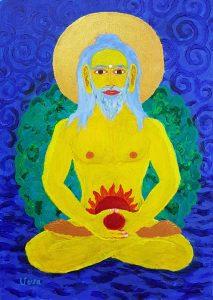
This lecture will be dedicated to two brilliant and leading disciples of the Buddha. They are Sariputta and Mahamoggallana in Sanskrit. In Pali they are called Sariputta and Mahamoggallana.
It should be noted that since some of the Suttas are written in the Pali language and some are written in Sanskrit, the pronunciation of the names is different.
Shariputra and Maudgalyayana, who were friends from a young age, sought the truth and studied with various teachers. When they were 30 years old, they studied with a teacher from a skeptical school which was similar to the skeptical schools in ancient Greece. One of them is the skeptical school of Socrates, which taught to doubt everything and to study things by examining their stability. The skeptical school advocated examining the philosophical structure of phenomena until it destroys it, when it discovers that this school reaches philosophical conclusions that contradict itself. This was Socrates' method. When a person came to him with philosophical knowledge in which he believed and was convinced of its truth, Socrates used to ask the person questions that deeply investigated the person's claim and revealed that the person was basing his worldview on contradictions, and then the person discovered that his claim in which he was convinced was not true. In this way, he was freed from illusion.
It is worth noting that Socrates valued good deeds and never denied their value, which made him not only a great philosopher who ruins others' philosophical amusements, but also a philosopher who teaches people to think and to think about good qualities.
This was the school in which Shariputra and Maudgalyayana studied, but they were not satisfied. They wanted to reach a state they called the eternal state. They wanted to reach a state in which the mind could overcome death. They did not find what they were looking for. And they promised each other that if one of them achieved this goal, he would immediately call his friend, so that they could walk together on this path. Not much is known about Shariputra except that he, like Maudgalyayana, came from a family of Brahmins, a family of scholars. It is said that Maudgalyayana's skin was brown with a blue tint like a blue lotus, and he was probably born into a Brahmin family from southern India, where there were black-skinned tribes. It is also said that Shariputra's skin was fair, and his family probably originated from northern regions of India.
The two friends traveled from place to place and one day Shariputra met the ascetic Asaji, who was one of the five ascetics who accompanied the Buddha, studied with him and received the first sermon in the deer park. The most learned of the five ascetics was Asaji, who was also their leader. One day Asaji went to collect alms in the village. When Shariputra saw him, he approached him and told him that he saw his face radiating light and his calm gaze. He asked him if he had found the eternal mind and who his teacher was. Asaji confirmed that he had indeed found the eternal state and that his teacher was Buddha Sakyamuni. Shariputra asked Asaji what the teacher was teaching them, and Asaji replied that he was not yet ready to convey the Buddha's teachings to him. Shariputra did not give up and urged Asaji to answer his question. Asaji relents and says that what his teacher teaches is that everything that is born will also die, and everything that has a cause will disappear.
Instead of leading him into pessimism, these words made him deeply happy. He discovered that Asaji had given him such a significant insight in such a direct and simple way from heart to heart, with an illuminated face. He told him that the eternal mind is beyond the world of births and deaths. It cannot be found in the body, in feeling, or in anything that can be perceived through the senses. Everything that is born and takes form will disappear. But the mind is not subject to birth and death. It does not take on the qualities of physical existence, and it is not destroyed either. This is what Shariputra discovered in Asaji's words. He discovered the eternal mind that cannot be seen, but it exists. It is a presence that Asaji radiated. Hearing these words, Shariputra felt a lightness and great appreciation. He went to Maudgalyayana and informed him that he had found the eternal mind. The two immediately went to the Buddha, and from then until the end of their lives they became a central factor in the life of the Sangha. Their spiritual development was so great that in a very short time they received all the teachings of the Buddha, and continued to fulfill them for nearly fifty years. They were the Buddha's right and left hands, and usually worked together. The Buddha used to call Shariputra as the one with the highest philosophical ability and asked him to guide new disciples when they came to study Dharma. His philosophical ability was greater than that of the Buddha, and therefore the Buddha used to call him a master who led all the philosophical teachings systematically and deeply until the disciples internalized them. From reading the sutras, one can notice a significant difference between the sermons that the Buddha gave and the sermons that Shariputra gave. Shariputra's sermons were the most precise that can be found. He used to take the Buddha's teachings and give them a refined, aesthetic and precise form. Buddha used to advise his disciples to listen to Shariputra. He also said that Shariputra's contemplative ability is so sharp that when he experiences meditative experiences, he does not get carried away by them, but analyzes them, and deciphers them.
When he had higher experiences, he always used to examine them critically. He examined the reasons for the emergence of a specific experience, and the timing of its emergence. Even when he entered the highest and most pleasant states of mind, he did not cling to them. He entered a state of mind easily, and also came out of it easily. He remained free regardless of which state of mind he experienced. For him, all these experiences were like rooms that he entered and left as the owner of the house. He taught his students to develop their power of identification so that they could see the states of mind that were rising and falling, and not cling to them, whether pleasant or unpleasant. When a person does not cling to pleasant states, he can easily not cling to unpleasant states, and if he clings to pleasant states, it is difficult to free himself from unpleasant states.
Whereas Shariputra was a champion and led the Sangha and taught the monks systematically, Maudgalyayana is considered in Buddhist history to be one of the greatest yogis, and one of the greatest magicians. He easily entered the worlds of gods, saw them, and taught them. The Buddha called him the healer of disciples. Whereas Shariputra taught the disciples, Maudgalyayana accompanied them on the spiritual path and helped them overcome all internal obstacles. In essence, Shariputra prepared the disciples and gave them a very basic education, while Maudgalyayana was a higher school for direct knowledge of the higher worlds.
Maudgalyayana preached not only to the gods but also to the demons and knew how to calm them. There is a story that illustrates the connection between Shariputra and Maudgalyayana. Shariputra was sitting under a tree in meditation, and Maudgalyayana saw a huge demon approaching Shariputra with an iron rod and about to hit Shariputra on the head with the rod. Maudgalyayana immediately reacted in a subtle way, weakened the force of the blow and expelled the demon. When Maudgalyayana asked how he felt, Shariputra replied that during meditation his head hurt, but then the pain suddenly went away.
There is another story in which Maudgliana saw a creature whose body shone like the body of a god, but whose mouth was full of worms. Maudgalyayana asked him how he explained his condition. The creature replied that he had done many good deeds, but his speech was bad, and he lived between two worlds: he partly lived in pleasure, and partly he suffered.
While alive, Maudgalyayana's mother was not sympathetic to the Buddhist dharma or its followers. When Maudgalyayana came to her house to beg for alms, she drove him out of her house with curses. Maudgalyayana left her house in sorrow, and the Buddha reassured him and told him that since he had been patient with her treatment of him, he would be able to help her, and so Maudgalyayana released her from hell after her death. Maudgalyayana and Shariputra died almost at the same time. In Buddhist language, their departure from the body is described as their entry into Nirvana, about a year before the Buddha's entry into Nirvana. With all the Buddha's peace, he expressed sorrow at the death of such leaders of the Sangha, who are like stars in the morning sky, appearing rarely, and how unfortunate it was that the Sangha was left without their leadership. They were over eighty years old, which was a very old age considering the time in which they lived. It can be said that all the work of the Buddha's Sangha was always supported by both of them. They worked tirelessly in the Sangha, and any monk or nun who needed help and guidance in practice found it from both of them. Shariputra and Maudgalyayana left in the Buddhist Dharma not only their brilliant personal history, not only the history of the establishment of the Sangha, but because of their different personal qualities, and because of the difference in dharma expertise between them, although they were good friends, they left the principle of union. Shariputra emphasized systematic study, analysis and concentration, while Maudgalyayana, with his power of vision, with his mystical power, was first and foremost a yogi who had no limits to his ability to see things. He was a god in a living body. These two abilities complemented each other in the Buddhist Dharma. Since then, the Buddhist Dharma has retained the union between a broad, sharp analytical mind and the power of a free mind, which reveals to a person an incredible depth of the world around him, a depth that reveals to the person that our world is not flat, that it is full of gods and demons and that one can preach to them too. This is the union that has always preserved the Buddhist Dharma from obstacles, as it was preserved by Shariputra and Maudgalyayana. These were qualities of deep knowledge, the vision of scientists, and Buddhist vision, and the knowledge to see and use supernatural vision of heavenly worlds.
It is worth preserving the blessing that Shariputra and Maudgalyayana gave to the Buddhist Sangha. It is worth remembering that when a broad mind, an inquiring mind full of the power of identification, unites with the power of right faith, both pave the way for success.