This lesson goes over the sutta “A Warning to an Evil Spirit, MN 50”, where Mahamogallana recounts one of his past births as a demon who wanted to hurt a Buddha and his disciples, “The Great Sutra of Buddha Amitabha's Pure Land”, Bhavachakra (Wheel of Existence), the Higher Realms and Stages of Enlightment.
The first sutta of this lesson is “A Warning to an Evil Spirit, MN 50”
- Who does Mahamagollana remember himself being?
- How did the demon try to penetrate into the minds of the disciples?
- What torment did the demon experience?
- What two paths clearly appeared before the evil spirit and what do they lead to?
The second sutta is The Great Sutta of Buddha's Amitabha Pure Land.
A video of the sutta is also available in Russian.
- Are the Pure Lands free from the three lower realms and provide beings refuge from suffering?
- How do inhabitants of the Pure Land nourish themselves?
- What are the three qualities of the Pure Lands?
- What are the bodies of beings incarnating in the Pure Lands like?
- What instructions does Amitayus give to Bodhisattvas who come the Pure Land in order to create similar lands?
- What qualities do Bodhisattvas who follow Amitayuses’ teaching develop?
Additionally, consider the wheel of existence (Bhavachakra):
https://onartandaesthetics.com/wp-content/uploads/2015/12/bhava-e1451136388672.jpg
Yamaraja, the King of Death, holds the wheel of existence. The wheel is divided into six sections. The upper section corresponds to the worldly god realm. Right below and to the left is the asura realm. The asuras constantly fight the worldly gods. On the other side on the same level is the human realm. At the bottom is the hell realm. To its right is the hungry ghost realm, and to its left is the animal realm.
Altogether, the Bhavachakra, higher realms, and stages of enlightment look as follows:
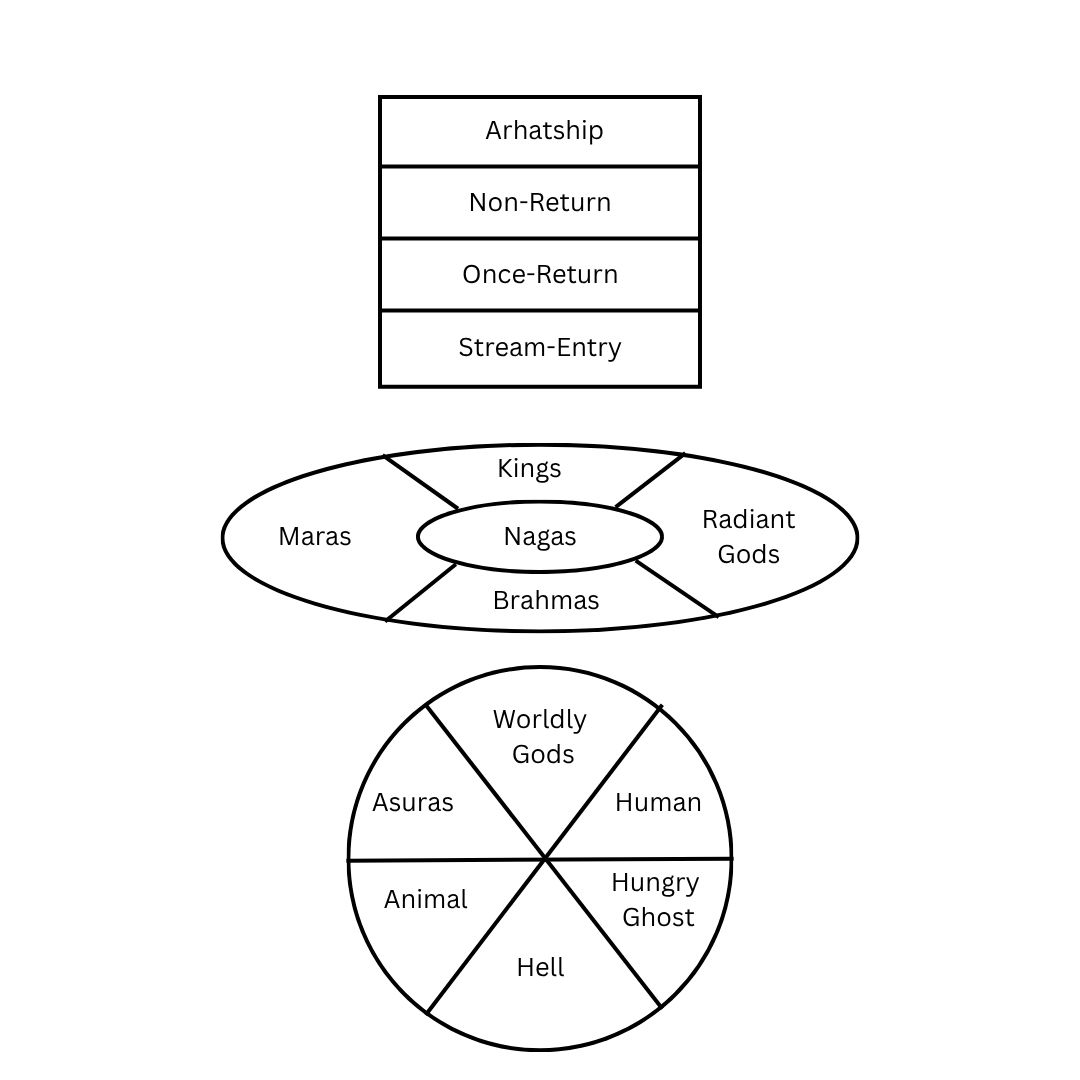
Bhavachakra is the bottom wheel. The higher realms, which reside above Bhavachakra, are the center disc, with the Nagas in the center, Maras on the left, Radiant Gods on the right, Kings at the top and Brahmas at the bottom. The stages of enlightment, which are above the higher realms, are stream-entry, once-return (the practitioner is reborn once), non-return (this is the practitioner's last birth), and Arhatship (enlightment).
Questions about the lesson
Why did the light encircle Amitabha three times?
- The light encircling Amitabha three times corresponds to the head sphere, heart sphere, and navel sphere; the three spheres have three centers: head, heart centre, and navel.
- Why does this light go and revolve around the body three times? This triple revolution of the body occurs in these centers thanks to the good actions of the mind, speech, and body. The wrapping of the head center with light occurs thanks to a good state of mind. The wrapping of the heart center with light occurs thanks to the good actions of speech. The wrapping of the navel sphere occurs thanks to the actions of the body.
- One shouldn't confuse this with the bindus in these centers, because the bindu in the head controls the body, the bindu in the heart controls the mind, and the bindu in the navel controls speech. But we must simply understand that the bindus express the relationship between the spheres; it is the bindus that connects the different spheres. Let's say the head bindu connects the sphere of the mind and the body, the mind controls the body, and so on. Beneficial actions of the mind lead to the circle beginning to shine around the head. The good actions of speech begin to wrap into light, and the heart sphere begins to shine. The body, the protective shell as a whole, begins to fill with radiance.
Do the circles protect the body?
- Yes. There is the notion of a protective shell; these circles resemble the protective shell. They also have other functions.
Regarding the Pure Lands: is each Pure Land individual to a being or is it shared among all beings?
- One can view it both ways
Do the fetuses grow?
- There is a point when those pleasures they receive stop being pleasant to them, they become satiated, just as a person can’t eat pleasant food endlessly. It eventually becomes boring to him, and he doesn’t want that food. When they become satiated with desires, they begin to understand that they did not find fullness of happiness, and that state begins to become tiring. They then leave that state and are reborn in the human realm, and then they study dharma to attain liberation. We need to remember that in the lotus sutta, it says that Buddha Maiytreya himself was in a state of a fetus, that he practiced Dharma for the sake of fame, honors, and turned into a golden fetus, and then when he returned, he didn’t remember what it means, what is the meaning of the Buddha’s sermon, and then he turned to Manjushri. That is in the first chapter. And Manjushri tells him, “You have once practiced for fame. That is why you do not remember what is the meaning of the Buddha’s sermon, but now you are ready and I’ll tell you.” He tells him the preacher about the burning house. What happens with them is that they return to earth as people who want to practice Dharma for the sake of liberating other beings, and not for the sake of their own pleasures.
Are fetuses higher than the human realm?
- Yes
What realm are the fetuses a part of?
- The realm of worldly gods, those who desire pleasure and forget about giving. They then descend to lower realms.
Where did the evil spirit disappear to?
- When we talk about the disappearance of a spirit, it means it became a spirit of place, merged with some space, became a spirit of place, and, as it received a wholesome sermon, began to uphold the triple gem in this place. That means that the spirit disappeared. It didn't disappear, it didn't go anywhere. As it says in the sutta with Vachha’s question — the Buddha says, when the fire has burnt out, where does it go? To the west? To the east? To the north? No, says, Vaccha. You can’t say that about it. The fuel disappears, the fire disappears. And considering that in this case fire expresses suffering and the fuel are passions, then when the passions of this spirit disappears, the delusion disappears, its burning manifestation also disappears. It disappears, but it also does not disappear, does not turn into nothing, because the wholesome energy of the sermon continues to exist. It is indestructible, and correspondingly, the spirit becomes a spirit of place and continues to keep this sermon. The sermon itself becomes the world of its dwelling. We can remember what the Buddha says, that it is like an ocean without boundary. A liberated mind is like the ocean, it has no boundary. It is filled with mysteries. This mystery is the life of liberated beings in the sermon itself. The Buddha’s sermon becomes, for the spirits, their Pure Lands. They continue to exist there, but in that place, in that specific place where it happened, even though it is a samsaric world, there continues to be a feeling of the good influence of this spirit. That is why we say it became a spirit of the place.
Can you reach the Pure Lands directly or do you have to go through all the realms?
- One does not have to be reborn in all the realms, although in the course of practice, a being may enter different realms, but in general, it’s possible to reach the Pure Lands directly.
Is there only one Buddha?
- No. The Buddha of this time is Buddha Shakyamuni, the one who discovered the teaching. There is the Buddha of the future, Buddha Maitreya. Before the current Buddha there were seven Buddhas.
What makes a Buddha different from an enlightened one (Arahat)? Why, for instance, was Sariputra not called a Buddha?
- The Buddha can create Pure Lands. The accumulations of a Buddha are sufficient to create his own Pure Lands. An Arhat often cannot yet create his own Pure Lands, and the three supermundane knowledges are less developed than the Buddha’s. The difference is in the amount of good accumulations, and it is expressed in this way. Buddha Amitabha was an Arhat of many lifetimes, but only when his accumulations became perfect was he able to create his own Pure Lands.
Why are the asuras always in fight with the worldly gods? (ans: to control)
- There is the owner of a company to whom the company belongs. It's his property. And there is the director of the company who does the administrative activity and manages all affairs. The director is jealous of the owner. He wants to be the owner himself. He manages things, he serves the owner, while the owner doesn’t do anything and only receives profit. The director is jealous. That is why often directors make plots against the owners. Same thing with the asuras. They are who govern. They are the technical directors, executors. Power is given to them, but things in samsara belong to the gods. So asuras feel jealous. Why do they work hard, while the gods receive the profit?
Do asuras do more than gods?
- Ans: either enjoy pleasures; or they practice giving
- Giving can be active. Beings who practice giving often work no less than asuras. Why does Avalokiteshvara appear in all realms? Because he always practices giving. When he preaches to rakshas, he appears in the form of rakshas. When he preaches to hungry spirits, he appears in the form of a hungry spirit; hell - hell spirit. In hell, he often looks like a skeleton. That is a very interesting image. In the animal realm — as a being with an animal head. Patroness of kung fu — tigress head. Appears in the form of a human in the human world. Among asuras — in the guise of an asura.
How can one be in Arhatship when there is non-return?
- Non-return means that a person does not have to return to samsara. He can not return to samsara. He may return if it's desirable, if it aligns with the purpose of giving. A non-returner person can return to samsara, but he would do that freely. Not because passions and desires draw him there, but because he thinks that there is work that this person needs to do.
What happens after reaching Arhatship? Is there more to it?
- Becoming a Buddha (one who can create Pure Lands)
How do beings go from the worldly god realm to the higher realms?
- By practicing Dhamma, specifically giving and disidentifying with body and name.
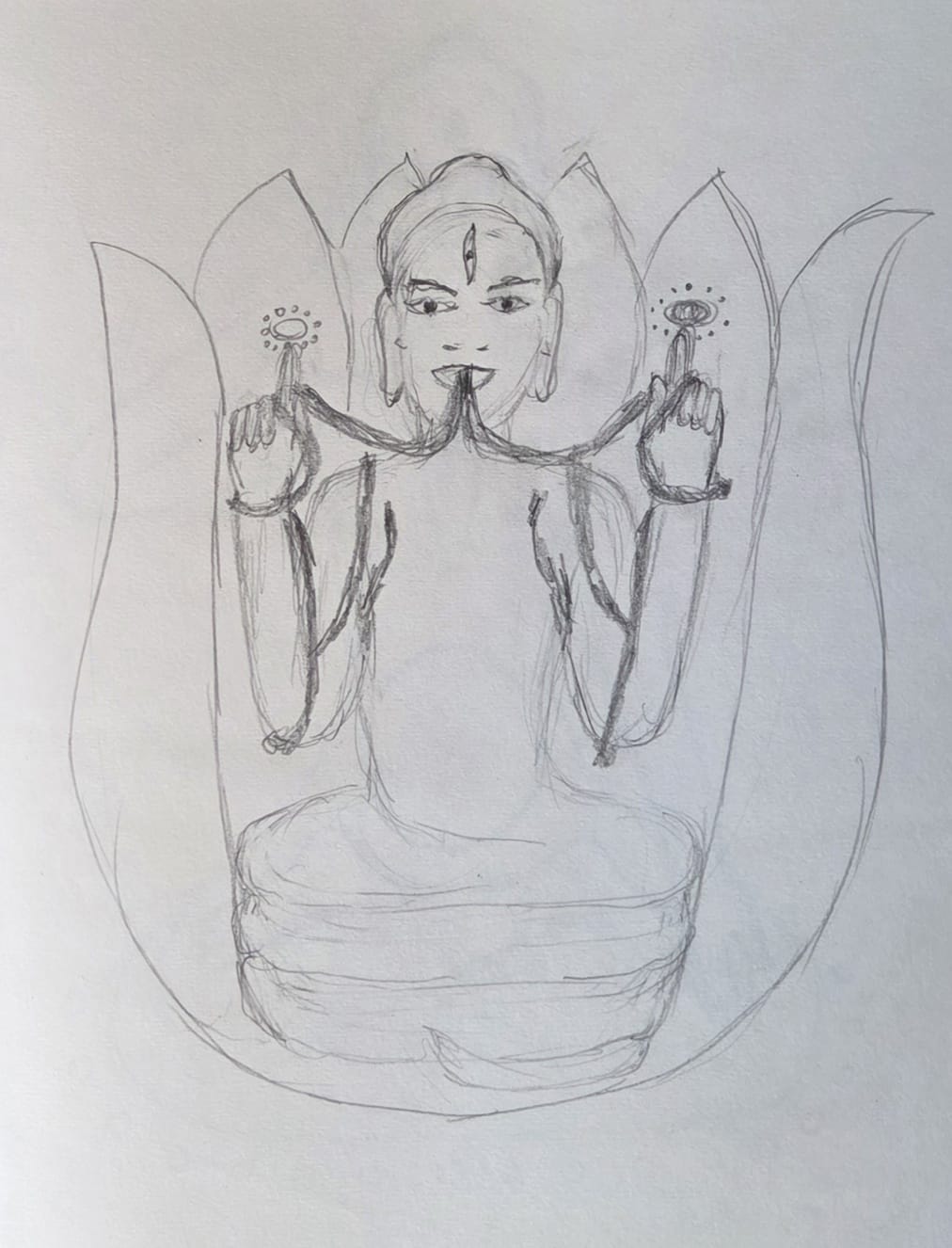
How do the Nagas look like?
Is there an end to Arhatship?
- No
Is it possible to attain all the states in one life?
- Yes
Do arhats continue to practice?
- Yes
In the Bhavachakra, what is depicted in the center?
- A pig, a snake, and a bird. These correspond, respectively, to the stains of passion, anger, and delusion.
It is important to hand the disciple's state to the disciple at end of the lesson.
If we take a good feeling with us, it's the same thing as eating from another’s plate.
If we take unpleasant feelings — that is not compassion; imagine a doctor who must help a patient, and instead of treating him and prescribing him medicine, he says, “oh, how poor you are, how unfortunate...”.
