
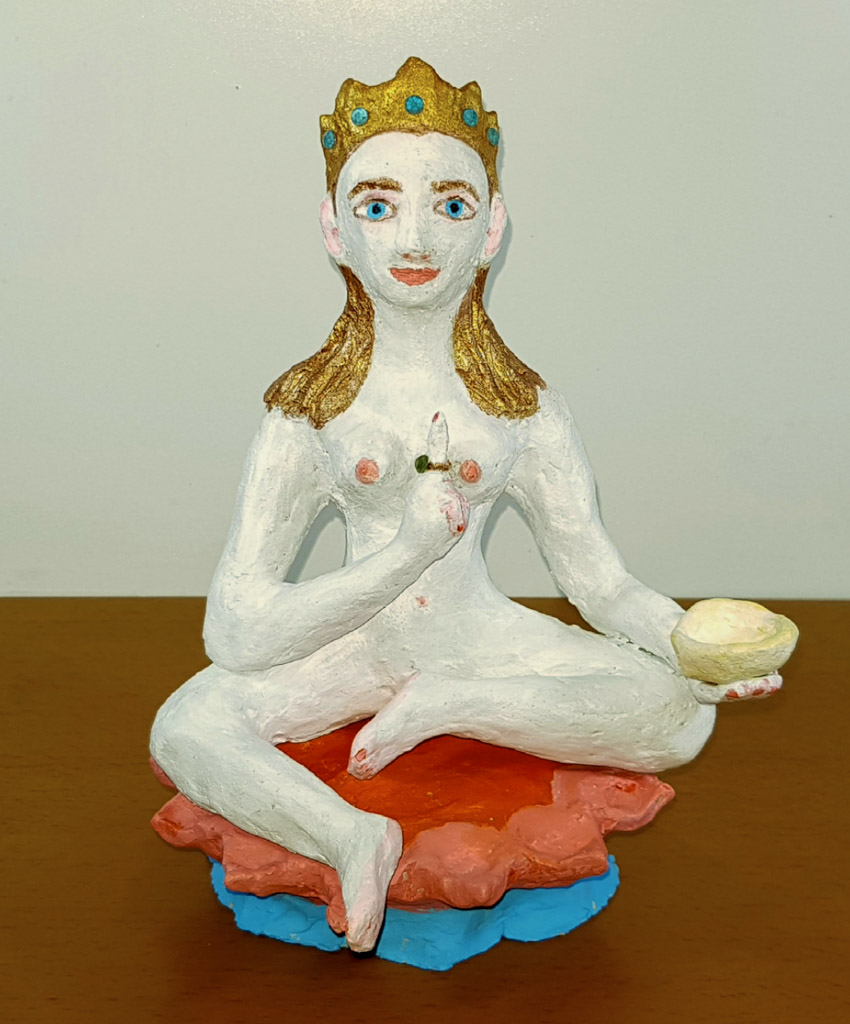
Retelling: Vova Pyatsky and Smadar Pyatsky (based on the translations of the suttas published on Theravada.ru and SuttaCentral.net)
Russian Version: 22. Махасатипаттхана сутта (Великое удержание чёток памятования) | Три Ваджры
Translation to English: Roni Sherman and Marina Sherman
Introduction
Mahasatipatthana sutta is a compendium of instructions on meditation on the body, senses, mind and attainment of Dhammas (in this text: Teachings which develop supermundane wisdom)
This sutta is commonly known as “The sutta on the foundations of mindfulness”. We translated its name as “The great hold of the rosary of mindfulness”, using the literal meaning of the word sutta (a string on which instruction-beads are worn) and the literal meaning of the word sati (memory), since the method presented in these instructions is like the counting of the rosary of mindfulness of impermanence, of the susceptibility to suffering and of the selflessness of the body, senses, mind and realization of Dhammas.
While in the trading place Kamasadhamma, the Buddha gave his followers these extensive instructions:
Meditation on the Body
Meditation on breath (1)
Secluded, sitting cross-legged with back straight, meditators capture the region of the mouth with attention. They recognize the characteristics of breath: whether the inhale is long or short, the exhale is long or short. Meanwhile the meditator is like a skilful potter who, by making a large turn of the pottery wheel, knows that he is making a large turn; by making a small turn of the pottery wheel, he knows that he is making a small turn.
Meditators exercise inhaling while feeling the inhale with the whole body and exhaling while feeling the exhale with the whole body. They form an intention to inhale while calming body strain and to exhale while calming body strain. Meditators observe how strain arises and how strain disappears. They thus see existence in the body.
Meditation on the position of the body (2)
Meditators notice the position of their body: whether they are walking, whether they are standing, whether they are sitting or whether they are lying down. They notice how these positions arise and how they disappear by being replaced by others. Meditators thus see the existence of the body.
Meditation on the actions of the body (3)
With keen powers of observation turned to the actions of the body, meditators notice how they step forward or backward; how they look straight ahead or to the side; how they bend or extend their limbs; how they wear a robe and bowl (clothes and things in their hands); they notice how they eat, drink, chew, taste; urinate and defecate; wake, including the different positions of the body, fall asleep, and wake up; how they speak or remain silent.
Meditation on the impurities of the body
Meditators imagine their body by surveying it from the hairs of the head to the feet and from the feet to the hairs of the head as a collection of impure constituents covered in skin: the hairs of the head, the hairs of the body, nails, teeth, skin; muscles, tendons, bones, bone marrow; kidneys, heart, liver, spleen, lungs, diaphragm; intestines (the gall and urinary bladder, the stomach), mesentery, pharynx, the brain; feces, urine, sweat; bile, mucus, pus; blood, salo, fat, tears, saliva, nasal mucus (ear wax), and transparent liquid.
The body should be seen as a bag filled with food: different varieties of grain, rice, peas, sesame seeds and other seeds. Meditators see the body the same way people see a bag and its content.
Meditation on the Four Great Elements (5)
Like a butcher who butchers the carcass of a cow into pieces and sits in the middle of them, the meditator sees the body as made of Earth, Water, Fire and Air.
The nine types of cemetery meditation (6)
Seeing the body of someone who has been dead for one, two or three days, swollen, blue and decaying, meditators think: “My body too is of the same kind, it is subject to this and won’t escape it”
Seeing the body eaten by crows, hawks, vultures, dogs, jackals, or by various kinds of worms, meditators reflect on this as their own future fate.
Meditators see the body which has become a skeleton with remains of flesh and blood on the bones joined by sinews…
A body which has become a skeleton with traces of blood without flesh…
A skeleton without traces of blood and without flesh…
A body which became a pile of bones scattered in different directions — wrists there, feet — there, skull — there, on the other side — the pelvis, breastbone, on another — vertebrae, and in another place — hand and leg bones…
A body of which there remains bleached, shell-colored bones…
Bones which had lain in a pile for over a year…
Decayed bones turned into dust…
Hermits eliminate attachment to the body by meditating on the body outwardly and inwardly, seeing its changeability, composite nature and inevitability of decay.
Meditation on the Senses
Hermits meditate on the experience of happiness and painful experience, understanding that their senses experience these states (There is no self these states would belong to). And neither pleasant nor unpleasant experiences (neutral experiences) — are also a state of the senses.
Hermits differentiate between sensation associated with the body and sensation not associated with the body in all three kinds of experiences: pleasant, unpleasant and neither pleasant or unpleasant.
They meditate on the senses by turning their attention inward and by turning their attention outward.
Meditators thus attain existence in the senses, their rise and disappearance, thereby eliminating dependence and attachment.
Meditation on the Mind
Hermits recognize the states of the mind: whether there is desire in the mind or the mind is free of desire; whether there is hostility in the mind or the mind is free of hostility; a mind with delusion or a mind free of delusion.
They recognize a focused state of mind and a dispersed state; a mind with developed wholesome qualities and an underdeveloped mind.
Hermits distinguish unfree states, in relation to which there is a higher state of mind, from the liberated state, in relation to which there is no higher state of mind.
They observe the mind when it is turned towards itself and when it is turned towards phenomena.
Meditators thus recognize existence in the mind, the rise and disappearance of states, and live independently, without being attached to anything.
Attainment of Dhammas
The Five Obstacles
Meditators discern the presence of five obstacles (hindrances), discern their absence, discern when an obstacle arises and when it disappears. Then they discern that there is no rise of the disappeared obstacle.
Thus in all these stages the meditator overcomes five obstacles: (1) sensual desire (greed, longing, lust); (2) ill-will; (3) drowsiness (sluggishness); (4) restlessness and anxiety (worry and anguish); (5) lack of confidence (doubt).
Meditators become aware of these qualities internally (by identifying awareness of the self with them and sensing them) and externally (by separating from them and reflecting on their selflessness).
Meditators thus recognize the existence of obstacles, their impermanence, and live without being bound by them.
The five groups of attachment
Meditators comprehend the rise and disappearance of the body (form), feelings, notions, residual impressions (impulses of volition arising from memory), and states of consciousness.
They comprehend the existence of the five groups of attachment which form a sense and notion about the self and live without being bound by them.
The six internal and external pillars of consciousness (ayatanas)
Meditators perceive the internal pillars of consciousness: the eye, ear, nose, tongue, body, thought (intelect); and the external pillars: form, sound, smell, taste, sensation, and ideas. They perceive the rise of fetters from the contact of the internal pillars of consciousness with the external pillars of consciousness, the existence of fetters, the disappearance of fetters, and the cessation of their rise.
The seven states of consciousness which express Enlightenment (factors of enlightenment)
Meditators perceive seven states of consciousness which lead to Enlightenment and which express Enlightenment: (1) mindfulness, (2) understanding of Dhammas, (3) firm determination, (4) inner rapture (collectedness of power in the heart, the ability to curb the mind like a rider riding a horse) (5) contentment (6) self-awareness (samadhi) (7) serenity (equanimity)
Knowing when an enlightened quality does not exist in the mind; when it exists; knowing when it reaches perfection, meditators attain the disappearance of attachment to everything worldly.
The Four Truths of the Noble View
Meditators realize: “Such is suffering; such is the origin of suffering; such is the cessation of suffering; such is the Path leading to the cessation of suffering”.
The truth about suffering
Birth, suffering, death, sorrow, pain, grief, despair, contact and connection with what is unpleasant, separation from what is pleasant, and non-fulfillment of what is desired — all these are traits of suffering. And all of them arise with the rise of the five groups of attachment — starting from the birth of the body, when the groups unite, and until death —- when the groups of attachment fall apart. The groups of attachment weaken, deteriorate, become decrepit with old age; when they encounter external or internal harm — sorrow arises as well as bodily pain and grief and despair experienced by the mind. The contact of the groups of attachment with what is unpleasant and the fruitless craving of the same groups (body, feelings, thought, volition and consciousness) for what is pleasant — is suffering. And the non-fulfillment of the desire for all this suffering to cease only by the power of the desire itself — is also suffering.
The truth about the origin of suffering
Suffering happens because of the ternary thirst, it leads to rebirth. Sensual thirst, thirst to prolong what is pleasant (the thirst to exist) and the thirst to destroy what is unpleasant (thirst for non-existence) — this is the ternary thirst.
The ternary thirst arises and exists wherever craving to what is pleasant arises: in the six internal and external pillars of consciousness; in their contact with each other; in the feeling arising from this contact; in the thought arising from that feeling; in the volitional aspiration arising from this thought; in the submersion of the consciousness arising from this volitional aspiration.
The truth about the cessation of suffering
The cessation of suffering consists in the extinction and disappearance of the ternary thirst, in discarding it and leaving it, in liberation from it. Thirst is discarded and fades away in the same place where it arises and exists, wherever craving for what is pleasant arises.
The truth about the Path leading to the cessation of suffering
There is the noble Path which allows us to liberate ourselves from thirst wherever it arises. It consists of eight parts:
- Correct knowledge of the Four Truths of the Path of the cessation of suffering
- Correct aspiration to renounce all evil
- Correct speech free of lies, of abuse, of idle chatter
- Correct action not associated with violence, theft, lust and greed
- Correct life-style aspired to the purification of the mind and based on wholesome behaviour
- Correct endeavor free of thirst, based on skilful states of consciousness (the seven factors of Enlightenment)
- Correct mindfulness of the body, the senses and mind, and of the attainment of Dhammas.
- Correct stay in the four jhanas, the degrees of the brilliance of consciousness: in a state of rapture form the separation of the mind from obstacles (the first jhana); the attainment of inner equilibrium based on self-awareness (the second); equanimity towards external experience, the bliss of the opening of channels (the third); equanimity to inner and outer experience (the fourth)
One who holds this rosary of mindfulness attains one of two fruits: Arhatship or, if traces of attachment still remain, Non-return (to the realm of samsara). The fruits of practice can be attained after diligent mindfulness over the long term, for example, in seven years, but this should not be taken as a measure: because it is possible to attain these fruits earlier.