
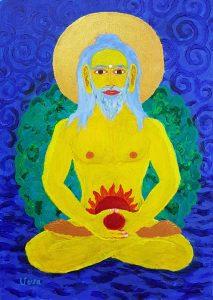
The first two basic sermons which the Buddha gave to his disciples built the nucleus of the Buddhist Sangha. They brought forth strong disciples who helped the Buddha build his Sangha. These were disciples whose backgrounds were diverse. The Buddha's first sermon was the sermon to the five ascetics who accompanied him, on the Four Noble Truths. He taught the ascetics about the suffering that exists in existence, and the causes of suffering.
In the first truth, he explained that physical existence is full of suffering. A man is immersed in suffering from the day he is born until the day he dies. In his life there is little joy and much sadness. A man suffers from the natural processes of aging, disease, death, disasters, and wars.
The causes of suffering must be sought in the mind of the person. There are also many external causes of suffering, and it is impossible to eliminate all of them, but the causes of suffering that are in the mind of the person can be eliminated.
The reasons in the human mind are the triple thirst: sensual thirst, thirst for existence, which is the thirst to repeatedly experience pleasant experiences, and thirst for non-existence, which is the thirst to destroy and reject unpleasant experiences by all means.
These are the first two truths: the truth about the existence of suffering, and the truth about the causes of suffering.
The third truth is that there is Nirvana, a state that is beyond suffering. It is an internal state, and it is not a place outside a person's mind where he will be protected from physical and emotional suffering. In life there are always troubles, but we can be in a state where our consciousness will be freed from dependence on physical existence, from dependence on subtle existence and even from formless existence. There is a state where consciousness can be freed from its own states.
When the mind can be liberated from its states, this is the definition of nirvana. States of mind are always in contact with suffering, since they are limited by external conditions. Our ability to discover the emptiness of the mind from all dependence and suffering, and to continue to enjoy, transforms the ocean of samsara, which is all unpleasant, into the ocean of the existence of gods, which is all pleasant. Whereas in the world of the gods of samsara there is the danger of the deterioration of consciousness, in the state of nirvana this danger does not exist. Suffering cannot arise again, and we are aware of being in a liberated state.
The Fourth Noble Truth assures that there is a path to reach the state of Nirvana, and the shortest path is right conduct, right concentration of mind, and right wisdom. These three faculties can be elaborated by the Noble Eightfold Path.
The Four Noble Truths were the sermon that the Buddha gave to the five ascetics. Before this sermon, the five ascetics were aware of this knowledge. They knew that suffering arises from internal causes, and they performed austerities in order to reach Nirvana. In fact, they were aware of the first three truths, but what they did not know was the way to reach Nirvana, the fourth truth. They believed in the concept of danda, which translates to stick. The meaning of danda is punishment. They perceived their physical existence as a punishment, as a stick for the shortcomings of consciousness. They believed that if they inflicted punishment on themselves through austerities, the stick would break, the punishment would end. When the stick of physical life was broken, sometimes together with their body, they would reach the state of Nirvana. The novelty of the Buddha's sermon was that he refuted this belief. He stated that this belief was incorrect since it was not possible to expel suffering with other suffering. There is no connection between us causing ourselves suffering and the possibility of being free from it. What liberates is only the calming of the mind, through right conduct, right concentration, and right insights, the mind can be freed from dependence on its state. Liberation from the fetters is achieved through relaxation and not through excessive effort. When the Buddha imparted this knowledge, the ascetics felt as if they were in a dark room illuminated by the candlelight of his words, because their minds were skilled in absorbing the first three truths. They put in a lot of effort to break the bonds that bound their minds, but as the efforts increased, the chains grew stronger and more powerful. The Buddha explained that when the chains oppress a person, the right way is to relax and not add chains and strengthen them. Through relaxation, the chains become loose and fall off. Ignorance bound the mind and it caused the body to become more tense, because of desires. The guidance he gave was to relax, to allow the body to become calmer and to abandon the ego's swelling, and as the body of consciousness becomes smaller and more humble, the chains fall off.
When the ascetics heard the Buddha's words, they immediately felt the chains that bound their minds fall off, and they quickly attained enlightenment. The five ascetics were so skilled that the Buddha's simple instruction helped them shed the chains of ignorance, since they lived in a culture where the phenomenon of asceticism was highly developed.
It is worth mentioning the important influence of Mahavira, who was one of the greatest ascetics in the history of India. The translation of his name is the great hero. He reached extremely high levels of knowledge, became remarkably liberated, and attained a degree of supernatural wisdom. Today, the heirs of Mahavira's teachings are the Jains. Jainism is one of the religions in India, and has much in common with Buddhism. The principle of ahimsa, the principle of avoiding harm to living beings, was adopted from Jainism by the Buddha. The doctrine of the six worlds, which is the essence of the cosmological doctrine in Buddhism, also originates from Jainism, as does the principle of right speech.
We must thank the fathers of Jainism, first and foremost Mahavira.
In the change that the Buddha made, he actually showed the ascetics a wise way to free themselves from the chains. He showed them a way that is the opposite of the overexertion that the Jains made. Overexertion only sometimes leads to spiritual achievements, and if there are spiritual achievements, they are not the product of the effort itself, but due to coincidence. The right direction is proper relaxation, which also requires efforts, but these are efforts that are intended to reach a relaxed state, and they are different from overexertion that may tear apart a person's life force and collapse him. Buddha showed how to properly reach the same goals that the ascetics wanted to achieve. They felt like a person standing in front of a wall, trying to get through it, believing that if he develops a strong force he can do so. He thus harms his body through the blows he experiences in this futile effort. Then the Buddha comes and shows them that there is a door in the wall and suggests simply opening it. The sermon on the Four Noble Truths, which was so profound and understandable that the Buddha gave in the Deer Park, is called the sermon in which he first turned the wheel of Dharma.
The Buddha gave the second sermon to his relatives: his aunt, his wife, his son Rahula, his father, and Ananda, the Buddha's brother-in-law, thanks to whom and thanks to his rare memory, the Buddha's sermons were recorded. Ananda served as the Buddha's personal attendant for twenty-five years. He also delivered his sermon to other people who lived in the palace. He gave this sermon on the Pure Land. He gave the sermon on the Four Noble Truths only to those who had already become monks and whose minds had been prepared. In his sermon on the Pure Land, the Buddha spoke of worlds of gods whose pleasures are above and beyond anything a person can experience in physical existence. The palace dwellers who believed in the Buddha and lived lives full of material wealth knew that this wealth and happiness were temporary. He explained to them that if they held on to temporary wealth, it would eventually disappear. When a person leaves his body, his wealth disappears, and when he receives a new birth, he may be born in a place where he will not have the comfortable living conditions he has. Therefore, it is important to utilize the material and emotional wealth and power in order to develop infinite feelings from which the Pure Land is made, where wealth and happiness will not be taken away from them.
This knowledge was given by the Buddha to Ananda, who lived in the palace and could compare temporary wealth and happiness with stable wealth and happiness that do not change. The Buddha explained why the Pure Land cannot be destroyed: because it is built from the light of infinite feelings: compassion, goodwill, dispassion, and joy. These are infinite feelings that create a better reality in every way, superior to physical reality. This sermon of the Buddha has great importance and influence on all Buddhist history, because the Buddha opened the gates that were close to the consciousness of his listeners. Buddhist teachers used to explain the Buddhist teachings in a language that was understandable to the listeners. We learn from this fact that when we teach Dharma, we do not impose on the students a set of words and a set of ideas. We open to a person a gate of insight that is closest and most suitable to his abilities and views. Therefore, the sermon on the Four Noble Truths was suitable for ascetics, who had exceptionally high intellectual abilities and great powers, abilities of powerful asuras seeking strong power in order to be liberated.
The sermon in the palace was essentially a sermon to the gods, since the existence of the palace dwellers resembled the existence of samsaric gods, worldly gods. When he describes to his family the heavenly palaces, the palaces of the Pure Land, where a person finds the pleasure that does not change, the pleasure of freedom.
It is correct to see the first two sermons given by the Buddha as talking about the same thing, but Buddha speaks to different people in a language they understand.
If we compare the way the Buddha spoke to the ascetics and the way he spoke to his relatives, we find that he was talking about the same thing. He was talking about training and developing infinite feelings. With the ascetics he was talking about developing right conduct and right wisdom in order to develop infinite feelings, and to his relatives he suggested developing the infinite feelings as they were, since they had these feelings for the Buddha, and these feelings connected them to the Buddha. He suggested that they develop these feelings to an infinite level, and thus they would open for themselves and others palaces in heaven that were independent of destruction and changing existence.